Auth0’s Password Strength feature allows you to customize the level of enforced complexity for passwords entered during user sign-up. Auth0 offers 5 levels of security to match OWASP password recommendations.
La fonction Password Strength (Fiabilité du mot de passe) n’est disponible que pour les connexions aux bases de données. La complexité des mots de passe dans les connexions Social et Enterprise est imposée par chaque fournisseur.
An important concern when using passwords for authentication is password strength. A strong password policy will make it difficult, if not improbable, for someone to guess a password through either manual or automated means.The following characteristics define a strong password:
Password Length: Longer passwords include a greater combination of characters making it more difficult to guess. Passwords shorter than 10 characters are considered weak.
Password Complexity: Passwords containing a combination of upper-case and lower-case letters, numbers, and special characters are recommended.
Passphrases: Sentences or combinations of words can be much longer than typical passwords yet much easier to remember.
Auth0’s Password Strength feature allows you to customize the level of enforced complexity for passwords entered during user sign-up. Auth0 offers 5 levels of security to match OWASP password recommendations.At each level, new passwords must meet the following criteria:
None (default): at least 1 character of any type.
Low: at least 6 characters.
Fair: at least 8 characters including a lower-case letter, an upper-case letter, and a number.
Good: at least 8 characters including at least 3 of the following 4 types of characters: a lower-case letter, an upper-case letter, a number, a special character (such as !@#$%^&*).
Excellent: at least 10 characters including at least 3 of the following 4 types of characters: a lower-case letter, an upper-case letter, a number, a special character (such as !@#$%^&*). Not more than 2 identical characters in a row (for example, 111 is not allowed).
La politique de mot de passe pour les administrateurs du Dashboard Auth0 reflète les critères définis pour le niveau Fair.
You can set a minimum length requirement for passwords that is independent of the policy strength requirements described in the Password Policies section.The minimum password length you can set is 1 byte, while the maximum is 72 bytes.
La limite maximale peut varier en fonction de l’algorithme de hachage de mot de passe que vous utilisez.
If you opt for a higher-level password policy, but you do not specify a minimum length value, the minimum password length for the policy level will automatically be used:
Niveau de la politique relative aux mots de passe
Longueur minimale du mot de passe
Aucun
1
Bas
6
Juste
8
Bon
8
Excellent
10
If you provide a minimum password length, this value supersedes that indicated by the password policy.
Step 2: Add password_complexity_options to leverage the new parameter
You’ll need to add password_complexity_options to leverage the new parameter. Add this option to the page’s script as follows:
Copier
<script> //code omitted for brevity new Auth0ChangePassword({ container: "change-password-widget-container", // required email: '{{email}}', // DO NOT CHANGE THIS csrf_token: '{{csrf_token}}', // DO NOT CHANGE THIS ticket: '{{ticket}}', // DO NOT CHANGE THIS password_policy: '{{password_policy}}', // DO NOT CHANGE THIS password_complexity_options: {{password_complexity_options}} // DO NOT CHANGE THIS //code omitted for brevity });</script>
To change the password strength policy, navigate to Auth0 Dashboard > Authentication > Database. Choose the database connection you wish to update and select the Authentication Methods tab. In the Password section, select Configure, then locate the Password Strength section:
If you use Management API to set or update a user’s password via the Update a User endpoint, the strength policy you set in Auth0 Dashboard applies.
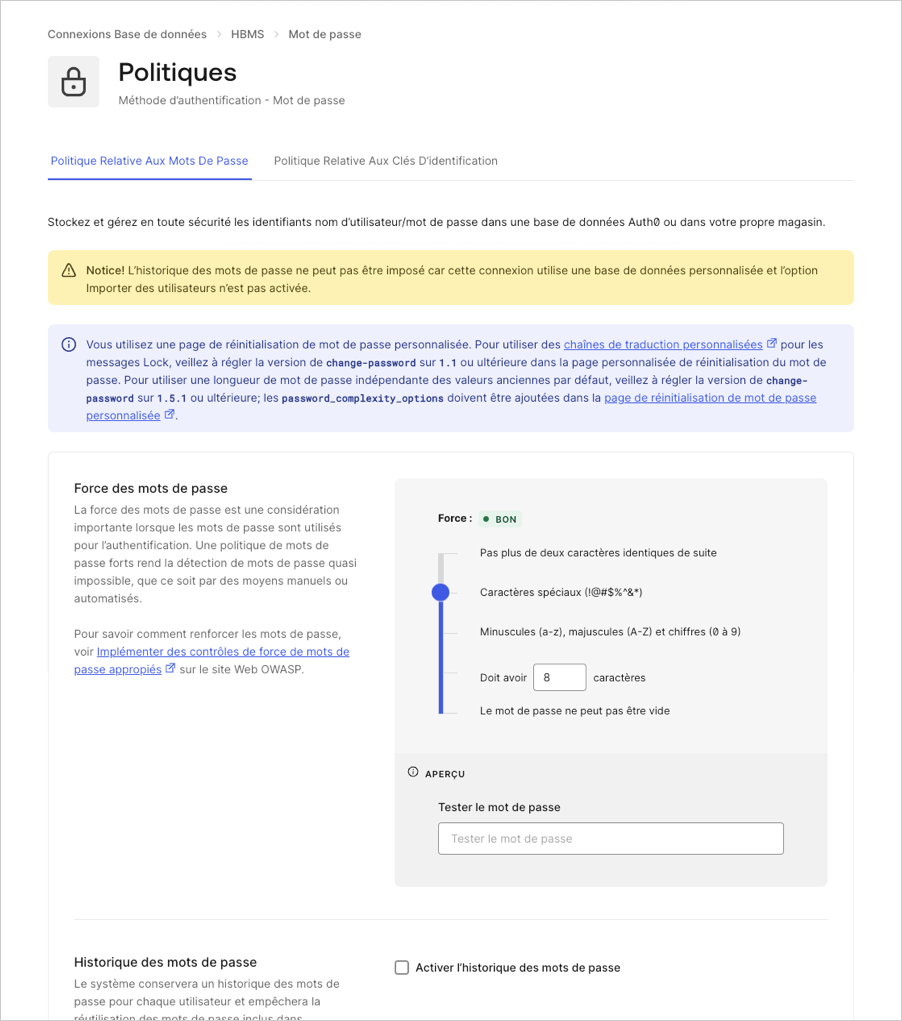
The new policy will be enforced on all subsequent user sign-ups and password changes. If the user enters a password that does not match the required criteria, the password will be rejected by Auth0 and the user will be asked to create one that complies with these requirements.
Les mots de passe existants qui ont été créés avant le changement de politique continueront à être validés.
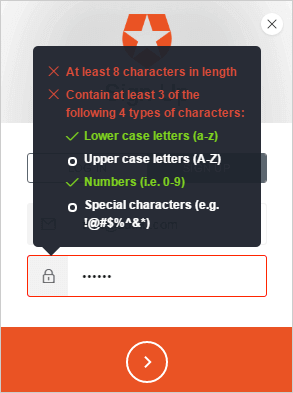
After password policies have been enabled, users will be notified on signup and reset password Lock modes if their password does not meet the required criteria.This is how Lock will appear on the desktop:
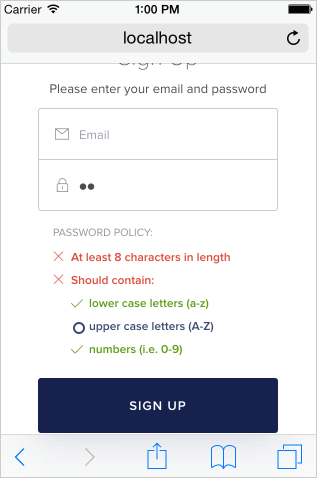
and on mobile:
Si Auth0 rejette un mot de passe, la notification s’affiche en anglais. Si vous souhaitez afficher les notifications dans une autre langue, vous devrez le faire via une traduction côté client.
Sign-up errors will return a 400 HTTP status code. The JSON response will contain code: invalid_password when the password does not meet the selected password policy criteria.The response will also contain additional information that can be used to guide the user to what is incorrect in the selected password:
A message is ready to be formatted using the printf function (or Node.js util.format).
format is an array with values to be used in the message. (message is separate from the format to allow easier i18n of error messages in custom UIs.)
verified can be either true or false. Returns false if the rule has been violated.
Certaines règles sont composites. Une règle peut contenir un champ items qui spécifie quelles sous-règles ont échoué. Chaque sous-règle aura un message et peut avoir un format, si nécessaire.
This is a sample description error report from a good policy with hello as the password:
Copier
{ "rules":[ { "message":"At least %d characters in length", "format":[8], "verified":false }, { "message":"Contain at least %d of the following %d types of characters:", "format":[3,4], "items":[ { "message":"lower case letters (a-z)", "verified":true }, { "message":"upper case letters (A-Z)", "verified":false }, { "message":"numbers (such as 0-9)", "verified":false }, { "message":"special characters (such as !@#$%^&*)", "verified":false } ], "verified":false } ]," verified":false}
This is a sample description error report from a good policy with hello1234 as the password:
Copier
{ "rules":[ {"message":"At least %d characters in length","format":[8],"verified":true}, {"message":"Contain at least %d of the following %d types of characters:","format":[3,4], "items":[ {"message":"lower case letters (a-z)","verified":true}, {"message":"upper case letters (A-Z)","verified":false}, {"message":"numbers (such as 0-9)","verified":true}, {"message":"special characters (such as !@#$%^&*)","verified":false} ],"verified":false} ]," verified":false }
In addition to the Password Strength feature explained here, the Password Policy settings for a database connection also include various Password Options that can further enhance your connection’s password policy and ensure that your users have more secure passwords. To learn more, read Password Options.